
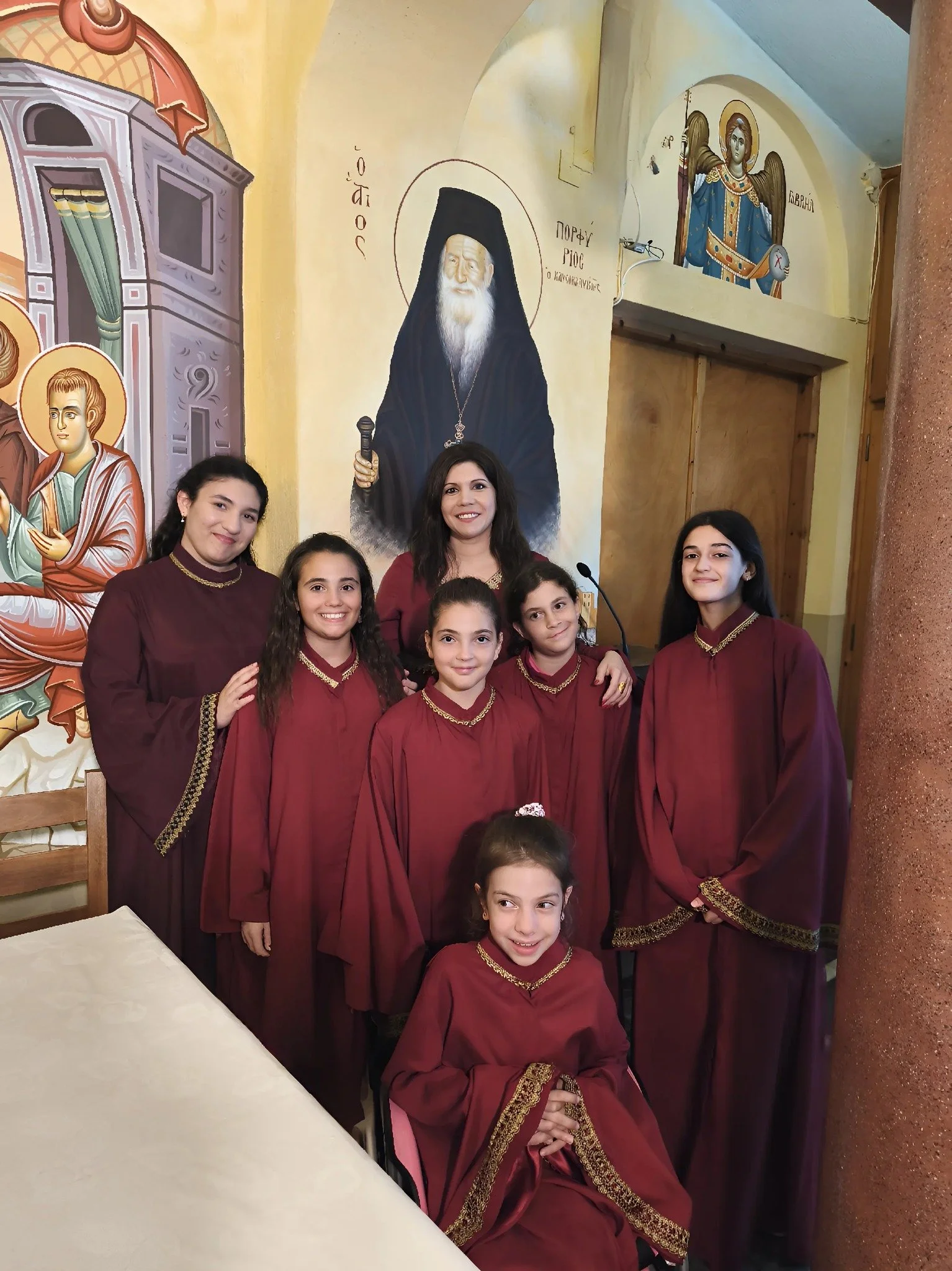
BYZANTINE MUSIC FOR GIRLS “YOUNG PSALTRIES”
The School for Psaltries encourages girls to engage with Byzantine Music from as early as preschool age through an original teaching programme developed by Nektaria Karantzi specifically for younger students. The programme draws on her many years of teaching experience, as well as on her own personal journey in the art of Byzantine chant, which she herself began studying in childhood.
Byzantine Music is introduced gradually, with teaching adapted to each child’s age, level of understanding and individual pace of development. Girls become familiar with Byzantine notation, develop their chanting technique and expression, and are introduced to the liturgical repertoire, while their studies are also enriched by elements of Greek folk and traditional music.
Particular emphasis is placed not only on accurate musical performance, but also on understanding the hymnographic texts. Children are encouraged to understand the meaning of the words and hymns they chant, so that from the very beginning their musical training is connected with the meaning of the texts, prayer and the liturgical experience.
For younger children, the programme also incorporates play-based and mnemonic teaching methods, with drawing used as one of its key educational tools. Images, colours, associations and creative activities help children retain musical concepts and engage with learning in a natural and enjoyable way.
Training is not limited to individual lessons. Upon enrolling at the School, girls also become members of the children’s Byzantine chant ensemble Nektar – Young Psaltries, gaining early experience of chanting together, working as an ensemble, and participating in the living liturgical and artistic practice of Byzantine chant.
Enquiries:
Tel.: +30 210 8022878, +30 210 8055507
FROM WHAT AGE CAN A GIRL BEGIN?
Girls can begin learning as early as preschool age. The teaching approach, course content and pace of progress are adapted to each child’s age and individual level.
IS ANY PRIOR MUSICAL KNOWLEDGE REQUIRED?
No. No previous knowledge of Byzantine Music or any other form of music is required. Each child begins at the appropriate level and progresses gradually.
HOW ARE LESSONS STRUCTURED?
Lessons take place once a week, either in small groups or individually. Particular emphasis is placed on individual tuition, as this allows the teaching to be tailored more precisely to each child’s needs, age, voice and individual pace of development.
WHAT DOES THE PROGRAMME INCLUDE?
The programme includes the gradual study of Byzantine notation, the development of chanting technique and expression, liturgical repertoire, theoretical elements adapted to the students’ age, as well as an introduction to Greek folk and traditional music. Particular attention is also given to understanding hymnographic texts, the relationship between words and melody, and familiarity with the liturgical tradition.
WHY IS DRAWING USED IN THE LESSONS?
For younger children, drawing, play and visual associations are used as mnemonic and educational tools. In this way, musical concepts are connected with images and experiences familiar to the child, helping to support both understanding and memory.
ARE LESSONS ALSO AVAILABLE ONLINE?
Yes. Lessons are also offered online, enabling children from across Greece and abroad to participate. In-person tuition is also available for students based in Attica.
DO THE GIRLS ALSO PARTICIPATE IN THE “NEKTAR” ENSEMBLE?
Yes. From the time they enrol at the School, younger students may become members of the children’s Byzantine chant ensemble Nektar – Young Psaltries, taking part in its shared educational, liturgical and artistic activities.
ARE THERE REGULAR GROUP SESSIONS FOR THE STUDENTS?
Yes. Members of Nektar meet regularly at the Hesychasterion of Saint Porphyrios in Milesi, Oropos, Attica, near Athens, Greece, where they take part in group lessons and ensemble preparation.
All of the School’s young students, including those who study online from other parts of Greece or from abroad, are warmly welcome to join these sessions whenever they are able to be in Athens. Throughout the year, the School is delighted to welcome young students from around the world who normally attend their lessons online and are able to take part in one or more of these gatherings during a visit to Greece.
These meetings give students the opportunity to chant together, meet fellow members of the School in person, and gain valuable experience of ensemble and liturgical practice..
DO STUDENTS TAKE PART IN TELEVISION AND EDUCATIONAL PROJECTS?
The shared educational sessions of the young chanters also form part of the School’s wider activities. Lessons and presentations are recorded for Nektaria Karantzi’s programme “Melismata and Myths” on Pemptousia TV, produced by the Saint Maximos the Greek Institute of the Holy and Great Monastery of Vatopedi (Mount Athos)
WHAT IS THE AIM OF THE PROGRAMME?
The aim is for each child to experience Byzantine Music not simply as another music lesson, but gradually to develop musical knowledge, chanting experience, an understanding of hymnographic texts, and a living connection with the liturgical and musical tradition, within an educational environment appropriate to her age.
WHEN DO ENROLMENTS TAKE PLACE?
Enrolments take place twice a year, in September and January.
WHEN ARE THE PLACEMENT EXAMINATIONS HELD?
Placement examinations are held every October.
HOW ARE STUDENTS ASSESSED DURING THEIR STUDIES?
Students’ progress is assessed through progression οn line examinations, which evaluate their development and determine whether they are ready to advance to the next level of study.
For younger students, progression follows a pedagogically adapted pace, according to each child’s age, level and individual development, and does not necessarily follow the same timetable as the adult programme.
IF MY DAUGHTER LIVES OUTSIDE ATHENS, GREECE, AND STUDIES ONLINE, WILL SHE NEED TO TRAVEL TO ATHENS FOR ANY EXAMINATIONS?
Students who live outside Athens — whether elsewhere in Greece or in another country — and enrol from the first year may complete all annual progression examinations online throughout their studies. She does not need to travel to Athens, Greece, where the School is based, either to enrol or to sit these examinations.
Under the applicable requirements of the Greek Ministry, in-person attendance in Athens, Greece, is required only for the following examinations:
Placement examinations, for students who already have prior knowledge of Byzantine Music and wish to enter the programme at a higher level rather than begin from the first year.
Degree examinations, taken upon completion of the Degree course in order to obtain the official state-recognised Degree in Byzantine Music.
Diploma examinations, taken upon completion of the advanced course leading to the Diploma in Byzantine Music, the qualification required for those wishing to pursue the teaching of Byzantine Music within the Greek state-recognised system.
Therefore, a young student living abroad who begins from the first year can follow her studies entirely online and will only need to travel to Athens, Greece, if she later sits a placement examination or reaches the final state examinations for the Degree and, should she continue, the Diploma.
CAN MY DAUGHTER STUDY BYZANTINE MUSIC WITHOUT WORKING TOWARDS A DEGREE OR TAKING ANNUAL EXAMINATIONS?
Absolutely. If she does not wish to work towards a Degree or Diploma in Byzantine Music, she may follow lessons without taking the annual progression examinations required for the formal course of study. Her progress is instead monitored continuously through her work and development during the year, allowing her to advance at an appropriate pace without the obligation of sitting examinations or pursuing a qualification.
If, at a later stage, she decides that she would like to enter the formal programme leading to a recognised qualification, she may take a placement examination when she is ready. This will determine the appropriate level at which she can enter the official course of study and continue towards the Degree and, subsequently, the Diploma in Byzantine Music.